Human resources professionals face an accelerating pace of technological change that’s reshaping how you attract, engage, and retain talent. AI tools for HR are no longer experimental—they’re becoming essential for staying competitive in today’s talent market.
This guide targets HR leaders, talent acquisition specialists, and people operations teams who need practical insights into the most impactful AI solutions available right now. You’ll discover how AI recruitment software can cut your hiring time in half, while employee engagement AI helps you predict and prevent turnover before it happens. We’ll explore game-changing AI-powered recruitment tools that eliminate bias while finding better candidates faster. You’ll also learn about intelligent automation solutions that free up your team from routine tasks so you can focus on strategic initiatives that drive business results. Plus, we’ll cover the ethical considerations, and implementation challenges you need to navigate for successful AI adoption in your organization.
AI-Powered Recruitment Tools That Transform Hiring

Automated Resume Screening and Candidate Assessment
When you implement AI recruitment software in your hiring process, you’ll discover how automated resume screening revolutionizes your approach to candidate assessment. These AI tools for HR enable you to process large volumes of applications quickly and efficiently, transforming what was once a time-consuming manual task into a streamlined operation.
Your AI hiring solutions work by analyzing resumes against predefined criteria that you establish based on your specific role requirements. The technology identifies suitable candidates by scanning for relevant skills, experience levels, educational backgrounds, and other qualifications you deem essential. This means you can review hundreds or thousands of applications in a fraction of the time it would traditionally take your HR team.
The beauty of this automated approach lies in its consistency. Unlike human reviewers who may experience fatigue or varying judgment throughout the day, your AI recruitment software maintains the same level of attention and criteria application for every single candidate. You’ll find that this consistency leads to more reliable initial screening results and helps ensure qualified candidates don’t slip through the cracks due to human oversight.
Bias Reduction for Diverse Workforce Building
Now that we’ve covered how AI processes applications, let’s explore how these AI tools for HR help you build a more diverse workforce. Your AI algorithms assess candidates based on objective criteria, which helps minimize unconscious bias that can inadvertently influence human decision-making during the initial screening phase.
When you utilize AI in human resources for recruitment, the technology focuses solely on the qualifications and skills you’ve defined as essential for the role. This approach helps remove subjective elements that might unconsciously favor certain demographic groups over others. Your AI hiring solutions evaluate candidates based on merit and relevant criteria rather than factors that shouldn’t influence hiring decisions.
The bias reduction capabilities of your AI recruitment software extend beyond just initial screening. These tools help you maintain consistency in how you evaluate all candidates, ensuring that everyone receives the same level of objective assessment. This systematic approach supports your diversity and inclusion initiatives by creating a more equitable hiring process.
Enhanced Candidate Experience Through Smart Communication
With this in mind, next, we’ll examine how AI transforms your communication with potential hires. Your automated communication tools keep candidates informed throughout the entire hiring process, significantly improving their overall experience with your organization.
These AI tools for HR manage candidate communications automatically, sending timely updates about application status, interview schedules, and next steps. You can ensure that no candidate feels left in the dark about where they stand in your hiring process. This consistent communication builds a positive impression of your company, regardless of whether you ultimately extend an offer.
Your smart communication systems can also handle frequently asked questions, provide instant responses to candidate inquiries, and schedule interviews based on availability. This level of responsiveness demonstrates professionalism and respect for candidates’ time, enhancing your employer brand in the competitive talent market.
Best Practices for Implementation and Integration
Previously, we’ve discussed the capabilities of AI recruitment tools, but successful implementation requires strategic planning. You need to define clear objectives for your AI use, such as reducing hiring time or improving candidate quality. These specific goals will guide your tool selection and help you measure success.
Your AI hiring solutions must seamlessly integrate with your existing HR systems to avoid creating data silos. When you maintain connected systems, you ensure that candidate information flows smoothly from initial application through onboarding, creating a comprehensive view of your recruitment pipeline.
Continuous monitoring of your AI tools’ performance is essential for meeting your recruitment goals. You should regularly assess whether the technology is delivering the expected results and adjust your criteria or processes as needed. This ongoing optimization ensures that your AI recruitment software continues to serve your evolving hiring needs effectively.
Employee Engagement Solutions Using Artificial Intelligence
Real-Time Sentiment Analysis and Feedback Processing
You’ll discover that AI systems revolutionize how your organization understands employee sentiment by continuously analyzing data from various communication channels. These sophisticated AI tools for HR monitor emails, chat messages, survey responses, and other digital interactions to gauge the emotional pulse of your workforce in real-time. Through natural language processing capabilities, your HR team can identify patterns in employee feedback that might otherwise go unnoticed.
Your AI-powered sentiment analysis tools detect subtle shifts in employee morale and performance indicators, enabling you to respond proactively rather than reactively. When these systems identify concerning patterns or sentiment trends, you can implement tailored interventions before issues escalate into larger problems. This real-time insight transforms your approach from damage control to prevention, creating a more responsive and supportive workplace environment.
The natural language processing tools integrated into your HR artificial intelligence systems excel at understanding context, tone, and underlying emotions in employee communications. You’ll find these tools particularly valuable for processing large volumes of feedback efficiently, something that would be impossible for human HR teams to manage manually while maintaining the same level of accuracy and speed.

Predictive Analytics for Employee Satisfaction and Retention
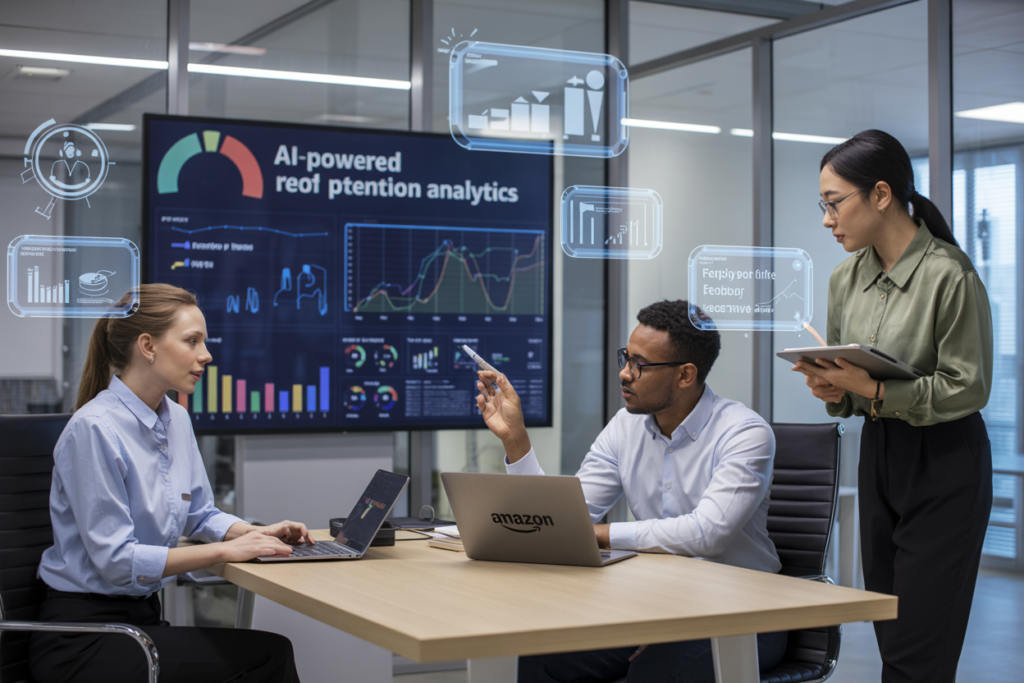
Now that we have covered real-time sentiment monitoring, your organization can leverage predictive analytics to anticipate future employee satisfaction levels and retention risks. These AI performance management systems analyze historical data patterns, current engagement metrics, and various workplace factors to forecast which employees may be experiencing declining satisfaction.
Your predictive analytics tools help you identify employees who might be at risk of leaving before they actually submit their resignation. By utilizing comprehensive data analysis, these systems enable your HR team to proactively address underlying issues that could impact retention. You’ll be able to intervene with targeted support, career development opportunities, or workplace adjustments based on the AI’s predictions.
The power of these AI hiring solutions extends beyond simple data crunching – they provide actionable insights that help you maintain a stable, satisfied workforce. When your predictive models identify potential satisfaction issues, you can address them through personalized approaches that demonstrate your organization’s commitment to employee wellbeing and professional growth.
AI-Driven Chatbots for Instant Query Resolution
With this foundation of sentiment analysis and predictive insights, your AI-driven chatbots serve as the front line for employee support and engagement. These advanced conversational AI systems provide immediate responses to routine employee queries, significantly reducing the burden on your HR team while ensuring employees receive instant assistance when they need it.
Your AI chatbots excel at handling frequently asked questions about policies, procedures, benefits, and general HR matters. By automating these routine inquiries, your human HR professionals can focus their time and expertise on more complex, strategic initiatives that require personal attention and nuanced understanding. This efficiency improvement directly contributes to better overall employee experience and satisfaction.
The sophistication of modern HR automation tools means your chatbots can understand context, maintain conversation flow, and escalate complex issues to human HR representatives when necessary. You’ll find that employees appreciate the 24/7 availability and immediate response times, while your HR team benefits from reduced administrative workload.
Personalized Employee Experience Optimization
Previously, we’ve explored how AI tools analyze and respond to employee needs. Now, your personalized employee experience optimization takes these insights and transforms them into individualized workplace experiences. These future of HR technology solutions create a workplace environment that’s truly attuned to each employee’s unique needs, preferences, and career aspirations.
Your AI systems use collected insights to anticipate individual employee challenges and opportunities, helping you sustain a consistently motivated workforce. Through personalized learning and development recommendations, career pathing suggestions, and customized workplace adjustments, you can demonstrate genuine investment in each employee’s professional growth and satisfaction.
The AI in human resources approach to personalization extends beyond one-size-fits-all solutions, instead creating dynamic, responsive experiences that evolve with each employee’s journey within your organization. You’ll find that this level of personalization significantly enhances employee engagement, loyalty, and overall workplace satisfaction, creating a competitive advantage in talent retention and organizational performance.
Performance Management Revolution Through AI Analytics

Objective Performance Evaluation and Bias Elimination
You can revolutionize your organization’s performance evaluation process by implementing AI performance management systems that eliminate the subjective elements that have plagued traditional reviews for decades. These intelligent systems ensure your evaluations are based on consistent and standardized criteria, removing the human biases that often skew assessment results. When you adopt AI-driven performance management tools, you’re enabling data-driven, objective, and fair evaluations that focus purely on measurable outcomes and behaviors.
Your AI system processes performance data against predetermined benchmarks, ensuring every employee receives the same level of scrutiny and evaluation standards. This consistency means you can trust that high performers are accurately identified while development needs are properly flagged across all team members, regardless of their relationship with managers or personal characteristics that might unconsciously influence human evaluators.
Personalized Feedback and Development Recommendations
Now that you understand how AI eliminates bias, you’ll appreciate how these algorithms provide tailored feedback based on each employee’s unique strengths and developmental areas. Your AI performance management system analyzes individual performance patterns, learning styles, and career trajectories to generate personalized development recommendations that foster a growth-oriented culture within your organization.
When you implement these AI tools for HR, you’re empowering your workforce with specific, actionable insights rather than generic feedback. Your employees receive customized suggestions for skill development, training programs, and career advancement opportunities that align with their individual performance data and organizational goals. This personalized approach ensures that your development investments yield maximum returns while keeping employees engaged in their professional growth journey.
The AI algorithms continuously learn from your employees’ responses to feedback and development initiatives, refining their recommendations over time. This means your personalized feedback becomes increasingly accurate and relevant, creating a dynamic development ecosystem that adapts to changing business needs and individual career aspirations.
Predictive Analytics for Future Performance Insights
With this personalized foundation in place, your AI performance management system can predict an employee’s future performance, enabling you to implement targeted interventions and provide proactive employee development support. These predictive capabilities transform your HR approach from reactive to strategic, allowing you to identify potential performance issues before they impact productivity or employee satisfaction.
Your predictive analytics tools analyze historical performance data, engagement metrics, and behavioral patterns to forecast future outcomes. You can identify employees who may benefit from additional support, those ready for advancement opportunities, and team members at risk of disengagement or turnover. This foresight enables you to allocate resources more effectively and create intervention strategies that address potential challenges before they manifest.
By leveraging these predictive insights, you can optimize your talent development pipeline, ensuring high-potential employees receive appropriate challenges and support while addressing performance gaps proactively rather than waiting for annual review cycles.
Real-Time Performance Tracking and Trend Analysis
Previously, you may have relied on quarterly or annual reviews to gauge employee performance, but AI’s ability to process vast amounts of data allows for real-time tracking that empowers you to identify trends and patterns as they emerge. This continuous monitoring capability enables you to adopt a proactive approach to performance management, addressing issues and recognizing achievements immediately rather than waiting for scheduled review periods.
Your real-time tracking system processes performance indicators continuously, providing you with instant visibility into productivity trends, collaboration patterns, and goal achievement rates. You can identify emerging performance trends across teams, departments, or individual contributors, enabling rapid response to both positive developments and potential concerns.
This immediate insight allows you to make data-driven decisions about resource allocation, team restructuring, and individual development needs. Your managers can provide timely feedback and support, while high performers receive immediate recognition for their contributions, creating a more responsive and engaging work environment that drives continuous improvement across your organization.
Streamlined HR Operations with Intelligent Automation
Automated Payroll and Benefits Administration
When you integrate AI tools for HR operations, you’ll discover that automated payroll and benefits administration becomes one of your most valuable assets. AI automation transforms your payroll processes by significantly reducing errors that commonly occur during manual data entry and calculations. Your organization will experience increased compliance as AI systems ensure that all payroll calculations adhere to current regulations and tax requirements without the risk of human oversight.
With AI-driven payroll systems, you can guarantee timely and accurate payments to your employees every pay period. The technology handles complex calculations, tax deductions, and various compensation structures automatically, eliminating the time-consuming manual processes that previously consumed hours of your HR team’s schedule. Your benefits administration also becomes streamlined through intelligent automation, as these routine tasks no longer require constant manual intervention from your staff.
Smart Employee Onboarding and Documentation
Your employee onboarding process undergoes a complete transformation when you implement AI-powered solutions. These intelligent systems facilitate a seamless onboarding experience that personalizes each new hire’s journey from their very first day. You can ensure that every new employee receives a customized onboarding experience tailored to their specific role, department, and individual needs.
The AI technology guarantees that your new hires have immediate access to all necessary resources, documentation, and information they need to succeed in their positions. Your onboarding process becomes more efficient as AI handles the distribution of materials, tracks completion of required tasks, and provides real-time updates on each employee’s progress through the onboarding pipeline. This personalized approach significantly improves the new employee experience while reducing the administrative burden on your HR team.
Compliance Tracking and Risk Management
Now that we have covered payroll and onboarding automation, your compliance tracking becomes another area where AI delivers substantial operational improvements. You can automate your compliance monitoring processes, ensuring that your organization consistently meets all regulatory requirements without constant manual oversight. The AI systems continuously track various compliance metrics and alert you to potential issues before they become problematic.
Your risk management capabilities expand significantly when you leverage AI for compliance tracking. These automated systems monitor employee data, policy adherence, and regulatory changes in real-time, providing you with comprehensive oversight of your organization’s compliance status. You’ll find that this automation frees up valuable time for your HR professionals to focus on strategic initiatives rather than routine compliance monitoring tasks.
Administrative Task Automation for Strategic Focus
With AI handling your routine administrative responsibilities, you can redirect your HR team’s energy toward more complex, strategic matters that drive organizational growth. AI automation manages various administrative tasks that previously required significant manual effort, including the deployment of chatbots to handle employee queries efficiently and accurately.
Your HR personnel gain the freedom to concentrate on strategic initiatives such as workforce planning, culture development, and employee engagement programs when AI tools for HR handle routine data processing and administrative workflows. The reduction in human error during manual data entry processes ensures that your HR analytics remain reliable and accurate, providing you with better insights for strategic decision-making.
The intelligent automation of these administrative functions creates a foundation for more strategic HR operations, allowing your team to focus on initiatives that directly impact employee satisfaction, retention, and organizational performance. Your HR artificial intelligence implementation becomes the catalyst for transforming routine operations into strategic advantages.
Diversity and Inclusion Enhancement Through AI

Unconscious Bias Detection in Hiring Processes
When you implement AI tools for HR, you gain access to powerful unconscious bias detection capabilities that can transform your hiring processes. These AI recruitment software solutions analyze candidate data free from human biases, creating a more objective evaluation system for your organization. Unlike traditional manual screenings that rely heavily on subjective human judgment, AI systems process applicant information without the emotional or cultural prejudices that often influence hiring decisions unconsciously.
Your AI hiring solutions work by examining patterns in your hiring data to detect when unconscious biases might be affecting your selection process. These systems can identify discrepancies in how candidates from different backgrounds are evaluated, flagging potential bias points that might otherwise go unnoticed. By implementing these tools, you’re not only improving fairness but also expanding your talent pool by ensuring qualified candidates aren’t overlooked due to unconscious preferences.
The technology examines various data points throughout your hiring process, from initial application reviews to interview scoring patterns. When your AI tools identify potential bias indicators, they alert your HR team to review specific decisions or adjust evaluation criteria. This continuous monitoring helps you maintain awareness of bias patterns that might emerge in your hiring practices, enabling proactive corrections before they impact your diversity and inclusion goals.
Neutral Job Description Creation and Optimization
Your job descriptions serve as the first point of contact with potential candidates, making neutral language crucial for attracting diverse applicants. AI tools for HR, particularly linguistic analysis platforms, revolutionize how you craft these descriptions by identifying biased language that might deter certain groups from applying to your positions.
These AI systems analyze your job postings for words and phrases that research has shown to appeal more to specific demographics. Specific terminology or eligibility criteria may inadvertently limit interest from a diverse range of candidates. Your AI recruitment software provides real-time suggestions for more inclusive alternatives, helping you create descriptions that resonate with a broader range of qualified candidates.
The optimization process goes beyond simple word replacement. These tools help you structure your entire job posting to be more inclusive while maintaining clarity about role requirements. By using AI-powered linguistic analysis, you can ensure your job descriptions communicate opportunities effectively to all potential applicants, regardless of their background or identity.
Anonymous Application Processing Systems
Now that we have covered bias detection and neutral job descriptions, your next step involves implementing anonymous application processing systems. These AI hiring solutions remove personal identifiers from applications before they reach your hiring managers, creating a level playing field for all candidates during initial screening phases.
Your anonymous processing system strips away information such as names, addresses, educational institutions, and other details that might trigger unconscious bias. This approach allows your hiring team to focus solely on qualifications, skills, and experience when making initial candidate selections. The AI technology ensures that demographic information doesn’t influence your hiring managers’ perceptions during the crucial first impression stage.
These systems work seamlessly with your existing HR artificial intelligence infrastructure, maintaining candidate tracking capabilities while preserving anonymity during key decision points. You can configure the system to reveal identifying information only after initial screening decisions are made, ensuring your selection process remains merit-based throughout the early stages.
Continuous Monitoring and Bias Auditing
With this in mind, implementing continuous monitoring and bias auditing becomes essential for maintaining ethical AI in human resources. Regular audits of your AI tools ensure they remain aligned with your diversity and inclusion standards while catching any unintended biases that might emerge from algorithm training processes.
Your monitoring system should regularly analyze outcomes from your AI hiring solutions to identify patterns that might indicate bias development. These audits examine whether certain groups are being systematically favored or disadvantaged by your AI systems, providing insights into algorithm performance across different demographics. This continuous oversight helps you maintain confidence in your HR AI implementation while ensuring ongoing fairness in your hiring practices.
The auditing process involves reviewing both the input data used to train your AI systems and the outputs they generate. You need to verify that your training data represents diverse populations adequately and that your algorithms aren’t perpetuating historical biases present in past hiring decisions. Regular bias auditing enables you to make necessary adjustments to your AI tools for HR, ensuring they continue supporting your diversity and inclusion objectives effectively.
Ethical Considerations and Implementation Challenges
Data Privacy Protection and Security Measures
When you implement AI tools for HR, you’ll face significant privacy concerns that require your immediate attention. Your organization must establish robust data security protocols to safeguard employee information from unauthorized access. As AI systems analyze vast amounts of personal data—from performance reviews to behavioral patterns—you need stringent privacy measures in place.
Your data protection strategy should encompass multiple layers of security. You must ensure that your AI recruitment software and employee engagement AI platforms comply with data protection regulations like GDPR and CCPA. This means implementing encryption protocols, access controls, and secure data storage solutions that prevent breaches while maintaining the functionality of your HR artificial intelligence systems.
You should also establish clear data governance policies that define who can access what information and under what circumstances. Your employees need to understand how their data is being used, stored, and protected within your AI hiring solutions and performance management tools.
Avoiding Over-Automation While Maintaining Human Touch
As you integrate HR automation tools into your organization, you risk diminishing the essential human element that makes HR effective. Over-automation can significantly decrease the necessary human touch in critical HR functions, particularly where empathy and human judgment are required.
You need to strike a strategic balance between automated processes and personal interactions. While AI performance management systems can efficiently analyze data and identify patterns, you must recognize that certain situations demand human intervention. Employee counseling, conflict resolution, and sensitive disciplinary actions require the nuanced understanding that only human professionals can provide.
Your implementation strategy should identify which processes benefit from automation and which require human oversight. You can use AI tools for HR to handle routine tasks like initial resume screening or scheduling, while preserving human involvement in final hiring decisions and employee development conversations. This approach ensures that your future of HR technology enhances rather than replaces meaningful human connections.
Transparency in AI Decision-Making Processes
You must implement AI in human resources with complete transparency to build trust among your workforce. Your employees deserve to understand how AI systems influence decisions that affect their careers, from recruitment to performance evaluations.
Your communication strategy should clearly explain when and how AI tools are being used in HR processes. You need to inform candidates when AI recruitment software is analyzing their applications and explain to employees how AI performance management systems evaluate their work. This transparency helps build confidence in your AI hiring solutions and demonstrates your commitment to fair practices.
You should also provide accessible explanations of how your AI algorithms make decisions. While the technical details may be complex, you can create simplified explanations that help employees understand the factors considered in AI-driven HR decisions.
Regular Algorithm Auditing for Fairness
You must continuously monitor your AI systems to ensure they promote fair and unbiased decision-making. Poor data quality can lead to inaccurate, biased outcomes that undermine your diversity and inclusion efforts. Regular auditing becomes crucial for maintaining the integrity of your AI in human resources.
Your auditing process should examine AI decisions for patterns of bias across different demographic groups. You need to establish metrics that measure fairness in hiring, promotion, and performance evaluation processes. This involves analyzing whether your AI tools for HR produce consistent results across various employee populations and identifying any discriminatory patterns.
You should conduct these audits quarterly or whenever you update your AI systems. Your HR AI implementation must include protocols for addressing bias when it’s discovered, including retraining algorithms and adjusting data inputs to eliminate discriminatory outcomes.
Proven Success Stories and Real-World Applications

Recruitment Efficiency Improvements and Time Savings
When you implement AI recruitment software, you’ll witness dramatic improvements in your hiring processes that directly impact your bottom line. Leading organizations across industries have already proven the transformative power of AI tools for HR recruitment, with results that speak for themselves.
You can achieve remarkable time-to-hire reductions by leveraging AI-driven recruitment platforms. A leading tech company experienced a 30% reduction in their hiring timeline after implementing an AI-powered recruitment solution. This improvement wasn’t just a minor efficiency gain—it represented a fundamental shift in how they approached talent acquisition, allowing them to secure top candidates before competitors.
Even more impressive results await you in the financial sector. A global financial institution demonstrated the true potential of AI hiring solutions by reducing their time-to-hire by an astounding 50%. This dramatic improvement enabled them to fill critical positions faster, maintain business continuity, and respond more effectively to market demands.
Your recruitment team will benefit from AI’s ability to screen candidates, analyze resumes, and identify the best matches for specific roles automatically. This automation eliminates the time-consuming manual review process while ensuring you don’t miss qualified candidates buried in large applicant pools.
Employee Engagement and Satisfaction Increases
Now that you understand recruitment improvements, let’s explore how AI performance management and employee engagement tools deliver measurable satisfaction gains. Your organization can achieve significant improvements in workplace satisfaction by implementing AI-powered engagement solutions.
You’ll see substantial engagement increases when you deploy the right employee engagement AI tools. A tech company boosted their employee satisfaction rates by 30% using an AI-powered engagement platform. This improvement translated into better retention, increased productivity, and a more positive workplace culture.
Your retention strategies become more effective when you leverage AI for employee sentiment analysis. A multinational corporation successfully improved their retention rates by proactively addressing workplace issues through AI-driven insights. The system identified potential problems before they escalated, allowing HR teams to intervene and resolve concerns early.
The performance management aspect delivers equally impressive results. A large multinational company reported a 30% increase in employee engagement after adopting an AI-driven performance management solution. This demonstrates how AI in human resources creates more meaningful connections between employees and their work.
Performance Management Productivity Gains
With this in mind, next, you’ll discover how AI transforms performance management into a productivity powerhouse. Your organization can achieve significant productivity improvements by implementing AI systems that provide detailed performance insights and personalized growth pathways.
A national retail chain serves as a perfect example of AI performance management success. You can expect similar results—they saw a 20% increase in productivity after adopting an AI system for performance analysis. This improvement came from the system’s ability to provide managers with actionable insights about individual employee performance and customized development recommendations.
Your managers will have access to real-time performance data, enabling them to make informed decisions about coaching, training, and career development. The AI system analyzes performance patterns and suggests personalized growth pathways for each team member, ensuring that your investment in employee development yields maximum returns.
Operational Cost Reduction and Resource Optimization
Previously, we’ve seen how AI impacts recruitment, engagement, and performance. Now, you’ll understand how HR automation tools deliver substantial operational benefits through cost reduction and resource optimization.
Your HR operations become significantly more efficient when you implement AI systems that automate routine administrative tasks. This automation reduces human error while freeing up your HR professionals’ time for strategic initiatives that drive business value.
You’ll achieve resource optimization as AI handles time-consuming tasks like scheduling, benefits administration, and basic employee inquiries. This shift allows your HR team to focus on high-value activities such as strategic planning, culture development, and complex problem-solving.
The cumulative effect of these improvements creates a more agile, responsive HR function that operates at lower costs while delivering higher value to your organization. Your future of HR technology investment pays dividends through improved efficiency, reduced operational expenses, and enhanced strategic capability.
Future-Ready AI Trends Shaping HR Innovation

Personalized Learning and Development Programs
With the evolution of AI tools for HR, you’ll find that personalized learning and development programs represent one of the most transformative applications of artificial intelligence in human resources. As HR technology continues advancing, AI will play an increasingly prominent role in tailoring personalized learning and development initiatives that align with your workforce’s unique needs.
Your ability to identify skill gaps becomes exponentially more accurate when leveraging AI-driven assessment tools. These systems analyze employee performance data, career trajectories, and industry benchmarks to pinpoint exactly where your team members need development. Rather than implementing one-size-fits-all training programs, you can now design targeted interventions that address specific competency gaps.
AI algorithms excel at suggesting targeted training programs that match individual learning styles, career aspirations, and organizational requirements. When you implement these systems, they continuously analyze employee progress, adjusting recommendations based on real-time performance indicators and learning outcomes. This dynamic approach ensures that your investment in employee development yields maximum returns while maintaining high engagement levels.
Advanced Predictive Analytics for Workforce Planning
Now that we’ve explored personalized learning capabilities, your strategic workforce planning can reach new heights through advanced predictive analytics. These AI-powered insights enable you to anticipate turnover patterns with remarkable accuracy, allowing for proactive talent retention strategies rather than reactive damage control.
When you utilize predictive analytics for workforce planning, you gain the ability to identify high-potential employees before they become obvious to competitors. These systems analyze performance metrics, engagement scores, skill development trajectories, and behavioral patterns to surface talent that might otherwise go unrecognized. Your talent management strategy becomes more sophisticated as you can allocate resources more effectively toward developing these identified high-performers.
The optimization of resources becomes particularly evident when you can forecast staffing needs, budget requirements, and training investments based on predictive models. HR managers can make informed strategic decisions using predictive analytics, transforming traditional reactive approaches into proactive workforce strategies that anticipate market changes and organizational growth patterns.
Enhanced Data-Driven Decision Making Capabilities
Previously, HR decisions often relied heavily on intuition and limited data points. However, AI-driven insights now empower you to make more informed strategic decisions across all aspects of human resources management. The transformation of data-driven decision-making becomes apparent when you can access comprehensive analytics dashboards that synthesize complex workforce information into actionable intelligence.
Your strategic decision-making process improves significantly when AI systems process vast amounts of employee data, identifying patterns and correlations that would be impossible to detect manually. These insights help you understand the true drivers of employee satisfaction, productivity, and retention, enabling more precise interventions and policy adjustments.
Emerging Technologies and Integration Opportunities
With this enhanced analytical capability in mind, your organization must prepare for emerging technologies and integration opportunities that will define the future of HR AI implementation. Continuous evaluation and adaptation of strategies becomes essential as new AI advancements emerge in the human resources landscape.
You’ll need to develop frameworks for learning from AI success stories within your industry while maintaining flexibility to integrate future technological developments. The competitive edge in talent management increasingly depends on your ability to assess, adopt, and optimize emerging AI technologies that enhance your human resources capabilities.
Your approach to emerging technologies should include regular assessment of integration opportunities that align with your organizational goals and workforce needs. This forward-thinking strategy ensures that your HR function remains at the forefront of innovation while delivering measurable value to both employees and organizational objectives.
Strategic Tool Selection and Implementation Framework
Comprehensive Needs Assessment and Goal Definition
Before diving into the vast landscape of AI tools for HR, you must first conduct a thorough needs assessment to identify your organization’s specific HR operational challenges and opportunities. This critical first step ensures that your AI implementation aligns perfectly with your strategic objectives rather than pursuing technology for technology’s sake.
Start by mapping out your current HR processes and pinpointing areas where inefficiencies, bottlenecks, or resource constraints are hindering your team’s effectiveness. Whether you’re struggling with lengthy recruitment cycles, declining employee engagement scores, or manual administrative tasks consuming valuable time, documenting these pain points provides the foundation for your AI tool selection strategy.
Equally important is establishing clear, measurable success metrics that will allow you to evaluate the effectiveness of any AI hiring solutions or HR automation tools you implement. These metrics might include reducing time-to-hire by a specific percentage, increasing employee satisfaction scores, improving retention rates, or achieving cost savings in administrative processes. By defining these goals upfront, you create a framework for measuring return on investment and ensuring accountability throughout your AI implementation journey.
Vendor Evaluation and Credibility Analysis
Once you’ve clarified your needs and goals, the next crucial step involves thoroughly vetting prospective AI tool vendors to ensure you’re partnering with credible, reliable providers. Your evaluation process should encompass multiple dimensions of vendor assessment to minimize risk and maximize the likelihood of successful implementation.
Begin by examining each vendor’s track record in the HR artificial intelligence space. Look for providers with demonstrated experience in your specific industry or organization size, as this expertise often translates to better understanding of your unique challenges and requirements. Request detailed case studies and testimonials from existing clients, paying particular attention to organizations with similar HR technology needs or operational contexts.
Comprehensive customer support and training offerings should be non-negotiable factors in your vendor evaluation. The most sophisticated AI recruitment software or employee engagement AI tools are only as effective as your team’s ability to use them properly. Ensure that prospective vendors provide robust onboarding programs, ongoing technical support, and regular training updates to keep your team current with new features and best practices.
Integration Planning and Scalability Considerations
Your AI tool selection must carefully consider compatibility with your existing HR systems and technology infrastructure. Even the most powerful AI performance management solutions will fail to deliver value if they can’t seamlessly integrate with your current HRIS, payroll systems, or other critical platforms your organization relies on daily.
Evaluate the ease of integration for each potential solution, prioritizing vendors that offer flexible APIs and robust integration capabilities. These technical features enable smoother data flow between systems and reduce the likelihood of creating isolated technology silos that complicate rather than streamline your HR operations.
Scalability considerations are equally critical, particularly as your organization grows or evolves. The AI in human resources tools you select today should accommodate future expansion, whether that means handling increased employee volumes, additional locations, or evolving functional requirements. Solutions that can scale seamlessly prevent the need for costly system replacements as your needs change.
ROI Analysis and Success Metrics Establishment
The final component of your strategic framework involves conducting comprehensive ROI analysis to ensure your AI investments deliver meaningful value to your organization. This analysis should balance upfront implementation costs against predicted returns, considering both tangible financial benefits and intangible improvements that enhance your organizational culture and employee experience.
Calculate the cost-benefit ratio by factoring in software licensing fees, implementation costs, training expenses, and ongoing maintenance requirements against projected savings from improved efficiency, reduced administrative burden, and enhanced decision-making capabilities. Remember to account for both immediate gains, such as time savings from HR automation tools, and longer-term benefits like improved employee retention or enhanced talent acquisition outcomes.
Consider the broader implications of your AI implementation, including potential cultural shift improvements that may not immediately translate to quantifiable metrics but contribute significantly to organizational effectiveness. These intangible benefits often prove to be among the most valuable outcomes of well-implemented HR AI implementation strategies.
Conclusion
The landscape of human resources is rapidly evolving, and AI tools are at the forefront of this transformation. From revolutionizing recruitment processes and enhancing employee engagement to streamlining operations and promoting diversity, these technologies offer unprecedented opportunities to optimize your HR functions. The key to success lies in understanding how AI can address your specific challenges while maintaining the essential human touch that defines effective HR practices.
As you start using AI in your HR department, remember that technology should help people, not take their place. First, find out what your needs are and what success looks like. Check that the companies you want to work with are trustworthy before you choose one. Most importantly, keep a good mix of technology and personal touch. Make sure to think about ethics, which means doing the right thing, and keeping people’s private information safe. The future of HR will be best for companies that can combine AI tools with human ideas, making the workplace better, fairer, and more enjoyable for everyone.